Mission X, Porsche’s newest hypercar concept, offers a glimpse into the direction the entire supercar industry seems to be heading.
Konstruct
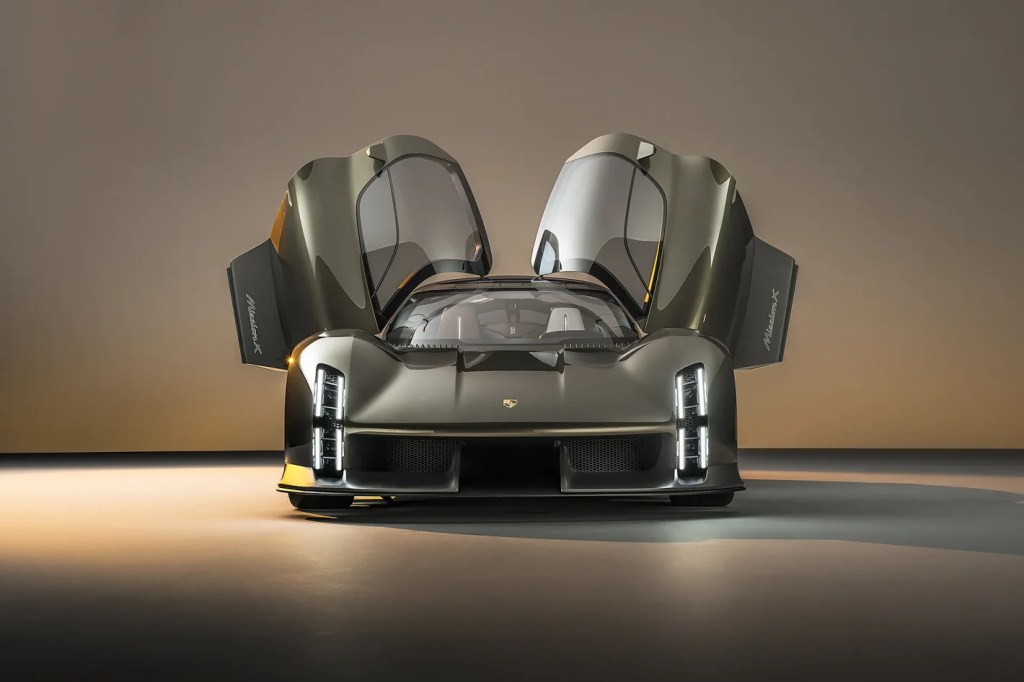
Porsche Mission X
As a company at the forefront of performance car development, Porsche has always strived to push the boundaries of engineering. Recently, that meant introducing the EV drive trains and opening a whole new chapter that promises enormous performance potential and driving dynamics.
Interestingly, for a company with such credentials, Porsche has produced only three supercars in its history. However, each one was a milestone for the segment and an instant classic.
The 959, Carrera GT, and 918 were triumphs of design and engineering, which not only introduced sublime performance and handling but also solidified the sucess of supercars in the future.
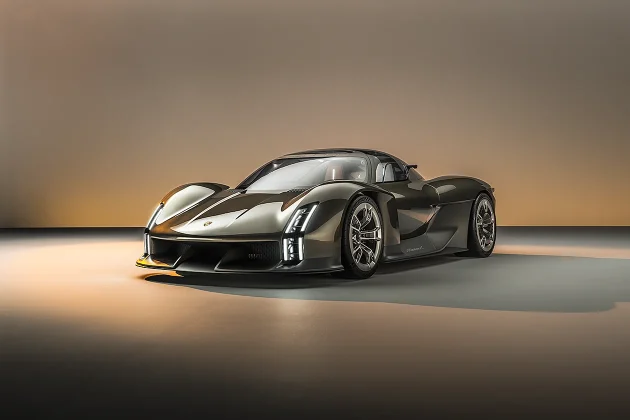
Porsche Mission X
That was precisely the idea behind the newest Porsche hypercar concept – the Mission X. Launched on the 75th anniversary of the presentation of their first model back in 1948, the Mission X offered a unique glimpse not only into Porsche’s future but the direction the entire industry of supercars seems to be heading.
This Porsche is not only the most lust-worthy object of any enthusiast’s desire, it is more importantly a golden standard against which future electric hypercars will be measured. So, let’s take a look at the top 5 Mission X features that are poised to change the industry in the next few years.
1:1 Power-to-Weight Ratio
The insane power figures are mandatory for all hypercars, but electric ones also have a significant weight penalty. Due to clever engineering, Mission X weighs only 1,521 kilograms, and its two electric motors (one on each axle) deliver an astonishing 1,500 hp.
This means that the power-to-weight ratio is 1:1, ensuring better throttle response, instant acceleration, and unbelievable driving dynamics. Compared to some other electric hypercars, Mission X is 25% to 30% lighter, which is a laudable achievement. Critics might say that Mission X has less power than Rimac Nevera, but it is also considerably lighter, and therefore faster. However, there is as of yet a lack of any official performance data.

Exoskeleton-Type Chassis Construction
If you look closely at the roof of Mission X, you will notice a carbon “spine” running across the cabin. This is just a part of a very specific “exoskeleton” type construction, which is simultaneously light and rigid, whilst providing this car with exceptional strength and safety. After all, with 1,500 hp on tap, the Mission X is capable of insane speeds, which is why everything counts. This is accredited to Porsche’s exterior designers who perfectly matched carbon chassis with bodywork and “Rocket Metallic” paint.
The wheels of the concept study feature elaborate details: the rear axle is fitted with almost transparent aero blades, which are designed like turbines for better cooling of the brakes.
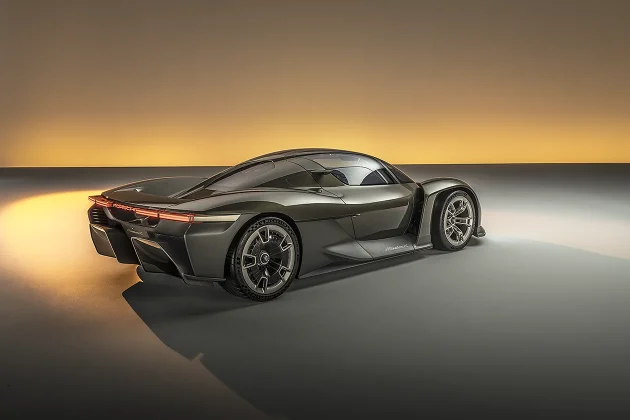
Porsche Mission X
Revolutionary 900-Volt Electrical System
Porsche is one of the pioneers of the fast charging process, which has premiered on its successful Taycan model. However, even with the advancements in this field, the charging times are often unacceptable to owners who want their cars ready to drive in minutes rather than hours. Yet, the Mission X has one more very important trick in its sleeve, and that is the 900-volt electrical system. This system is more powerful than anything currently on sale. It is also more complicated and demands a Type 3 charger station (supercharger), but it promises to reduce the charging times. Unofficially, this Porsche can charge up to 80% of its battery in a similar time you’ll need to fill up a gas tank. That is not just fast; it’s revolutionary, and addresses one of the biggest problems of any EV.
Le Mans-Style Driving Experience
Porsche promises a unique driving experience, and although many manufacturers use the same terminology, in this case, we can see that Porsche is delivering on the promise. Apart from the insane 1:1 power-to-weight ratio, and racing-style doors, a big part of the experience is the cabin itself and the driver’s surrounding. Mission X looks like a cross between race-ready Le Mans bolide and 911 with premium materials and a characteristic dashboard design combined with special seats and a center console steering wheel, similar to Tesla’s yoke design. Nevertheless, Porsche sidesteps accusations of copying Tesla’s solution by using its own Le Mans-winning cars and their special racing steering commands for inspiration.
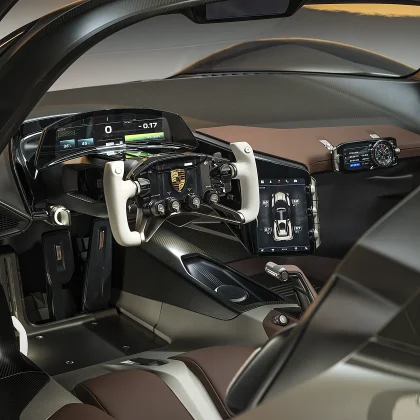
Porsche Mission X
Mission X shows that Porsche is convinced that the future of the upper echelon of the performance market is electric, and it is not afraid to explore this territory in its own meticulous and perfectionistic way.
To say that the result is astounding would be an understatement, but the best thing is that Mission X will be put into production in the near future. If all innovations are kept and improved, the hypercars will single-handedly write the next chapter of Porsche’s legend, and become the point of inspiration for the industry.
Excerpts: JamesEdition