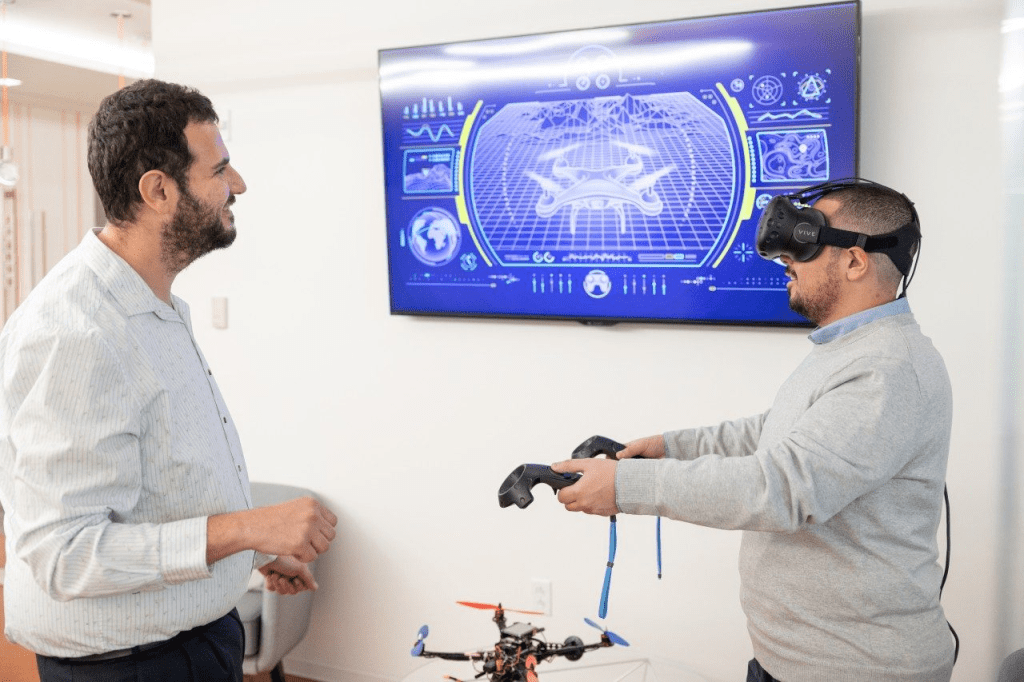
Source: Virginia Tech
Virginia Tech researchers say a true revolution in wireless technologies is only possible through endowing the system with the next generation of artificial intelligence (AI) that can think, imagine, and plan akin to humans. Doing so will allow networks to break free from traditional enablers, deliver unprecedented quality, and usher in a new phase of the AI evolution.Share:
FULL STORY
There’s a key difference between humans and current AI: common sense. According to Walid Saad, a professor at Virginia Tech, a true revolution in wireless technologies requires next-generation AI that can think, imagine, and plan like humans.
Published in the IEEE Journal’s Special Issue on the Road to 6G with Ph.D. student Omar Hashash and postdoctoral associate Christo Thomas, the paper suggests:
- The missing link in the wireless revolution is next-generation AI.
- The missing link in the next generation of AI is wireless technologies.
- The solution is to bring AI closer to human intelligence through common sense.
“We’re looking at least 10 or 15 years down the line before we have a wireless network with artificial general intelligence [AGI] that can think, plan, and imagine,” said Saad, a professor in the Bradley Department of Electrical and Computer Engineering. “We have a blueprint and road map. The entire vision might not be deployable immediately, but parts can be implemented now. This paper aims to show that there is a step-by-step path to a revolutionary, thinking wireless network.”
Previous wireless networks improved core components with new antennas and communication technologies. Researchers note that even the leap from 5G to 6G, involving AI in wireless systems and open radio access networks, won’t be sufficient for future needs.
“That is where things become thrilling,” Hashash noted. “The next generation of wireless networks and AI are converging, but few realize how seamlessly they can merge.”
Physical networks endowed with AI
At first, Saad, Hashash, and Thomas focused on the metaverse and the exploration of 6G by embedding AI across wireless systems, known as AI-native networks.
Saad noted the limitation of classical AI tools, stating, “The problem is researchers are using classical AI tools that are designed for other tasks such as computer vision.” He emphasized that old-school AI cannot effectively mirror the real-world for the metaverse, as current AI systems lack common sense, which is essential for navigating unforeseen scenarios.
While current AI captures patterns from data, it struggles with reasoning and generalization in novel situations. The future of 6G aims to enhance AI’s effectiveness to improve sustainability, trustworthiness, and explainability.
To fully integrate physical, virtual, and digital realms, next-gen wireless systems will require extreme quality-of-service and advanced AI capabilities, achieving seamless orchestration similar to human-like decision-making.
Hashash further explained that the convergence of the metaverse with AI advancements could enable novel applications such as cognitive avatars needing common sense abilities.


luxury | February 3, 2025
Private Islands for sale under $500,000
Luxury | January 28, 2025
Top 10 Most Expensive Rolex Watches on the Market

UNDERSHOW- Pre Release
How the Elite Profit from War, Waste, and Government Secrets[Part 1]
The metaverse, featuring applications like digital twins, offers networks opportunities to enhance perception, planning, and reasoning. This could enable networks to navigate unforeseen obstacles and predict scenarios beyond their training.
“We need wireless networks that understand the mechanics of AI models and the physical properties of objects,” Thomas emphasized. “This requires integrating mathematics, category theory, and neuroscience to better understand the human brain and the physical world.”

The researchers advocate for a paradigm shift beyond incremental advances, aiming for a system with human-level intelligence, merging the digital realm with future wireless networks. This AGI-native network would empower digital twins, yielding a new generation of human-like AI agents.
“The wireless network and its components like digital twins are the missing link for achieving human-like thinking,” Saad explained. “This could overcome current network limitations and usher in a new era of wireless networking, benefitting both wireless technology and AI.”
Story Source:
Materials provided by Virginia Tech. Original written by Florence Gonsalves. Note: Content may be edited for style and length.