Source: Flinders University
To understand why kangaroos hop — a rarity among animals — researchers have studied the musky rat-kangaroo (Hypsiprymnodon moschatus), a diminutive marsupial that weighs only 500 grams but is the last living representative of its family and part of a lineage that extends back to before kangaroos evolved their distinctive hopping gait.
FULL STORY
The evolutionary history of kangaroos, which are the only hopping animals with body masses greater than 5kg, cannot be understood without considering the origins of their diverse locomotor behaviours, especially hopping.
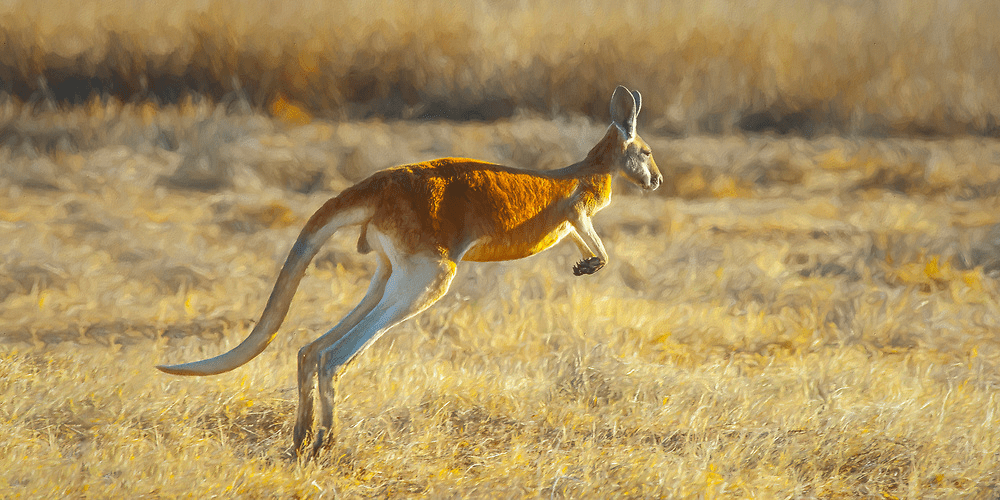
“The musky rat-kangaroo, as the most primitive living macropodoid (a group that includes kangaroos, wallabies, potoroos and bettongs), can offer insight into evolution within the group, including the origin of bipedal hopping locomotion,” says co-lead author Amy Tschirn, a PhD student and researcher at Flinders University’s College of Science and Engineering.
“As the only living macropodoid that doesn’t hop, the musky rat-kangaroo provides a crucial insight into how and when the iconic hopping form of locomotion evolved in Australia.”
This study observed muskies in their native habitat in the Atherton Tableland, far-northern Queensland, to better understand how they move.
Adult musky rat-kangaroos were filmed in the wild, which showed they mostly use a “bound” or “half-bound” gait, characterised by the hindfeet moving together in synchrony.
No other marsupial that moves on all fours is known to use this distinctive style of movement to the same extent as muskies.
Observations also confirmed that musky rat-kangaroos are restricted to quadrupedal gaits even at very fast speeds.
“There remains no evidence of hopping in this species. Even when travelling at high speeds, muskies always use quadrupedal gaits, never rearing up on just their back legs,” says Harvard’s Dr Peter Bishop, co-lead author of the research paper.
“These results support the hypothesis that a shift to an asymmetric-gait-dominant locomotor repertoire was a functional prerequisite in the evolution of bipedal hopping in macropodoids.”
Combined with further investigation of the musky rat-kangaroo’s anatomy, these observations help provide more understanding of how and why kangaroos adopted their distinctive bipedal hopping behaviours.
These results indicate a pathway for how bipedal hopping evolved in kangaroos, likely starting with an ancestor that moved on all fours. Over time, adaptations allowed it to hop more energetically and efficiently, involving changes in skeletal structure and muscle development for greater agility and speed. Ultimately, these adaptations refined movement mechanics, resulting in the iconic kangaroo hopping seen in Australia today, emblematic of the continent’s unique wildlife.

Most Populars
>Breakthroughs in HIV Treatment
>Links between metabolism and aggressive breast cancer >Tigers in the Neighbourhood: How India Makes Room for Both Tigers and People

While the evolution of kangaroo movement is yet to be solved, or an explanation of why hopping kangaroos got so much bigger than rodents, the researchers say future studies will be informed by key fossil discoveries from early periods in kangaroo evolution.
Story Source:
Materials provided by Flinders University. Note: Content may be edited for style and length.