Konstruct Telemedia
Tesla (TSLA) and BYD (BYDDF) are the world’s largest electric-vehicle makers.
In 2022, China EV and battery giant BYD’s vehicle sales raced ahead of Tesla’s and are now well more than twice as high, three times as much in Q4 2024. For all-battery electric vehicles (BEVs), BYD seized the crown in Q4, though Tesla led by a hair for 2024.
Both Tesla and BYD set quarterly delivery records in Q4, but Tesla’s annual deliveries fell for the first time. Tesla earnings came in light, even with a bitcoin boost.
Tesla stock skyrocketed in late 2024 as investors bet on Full Self-Driving, robotics and AI, with hopes that the incoming Trump administration would greatly favor Elon Musk. But Tesla stock has sold off sharply, amid concerns that self-driving deadlines will be missed again and fears that Musk’s political role is further damaging the brand and thus sales.
Deliveries for the new Model Y have begun, which should support sales.
Meanwhile, BYD recently surged to record highs amid its move to roll autonomous driving tech across its lineup to EVs as low as $10,000. Sales are off to a strong start in 2025.
Tesla Vs. BYD Sales
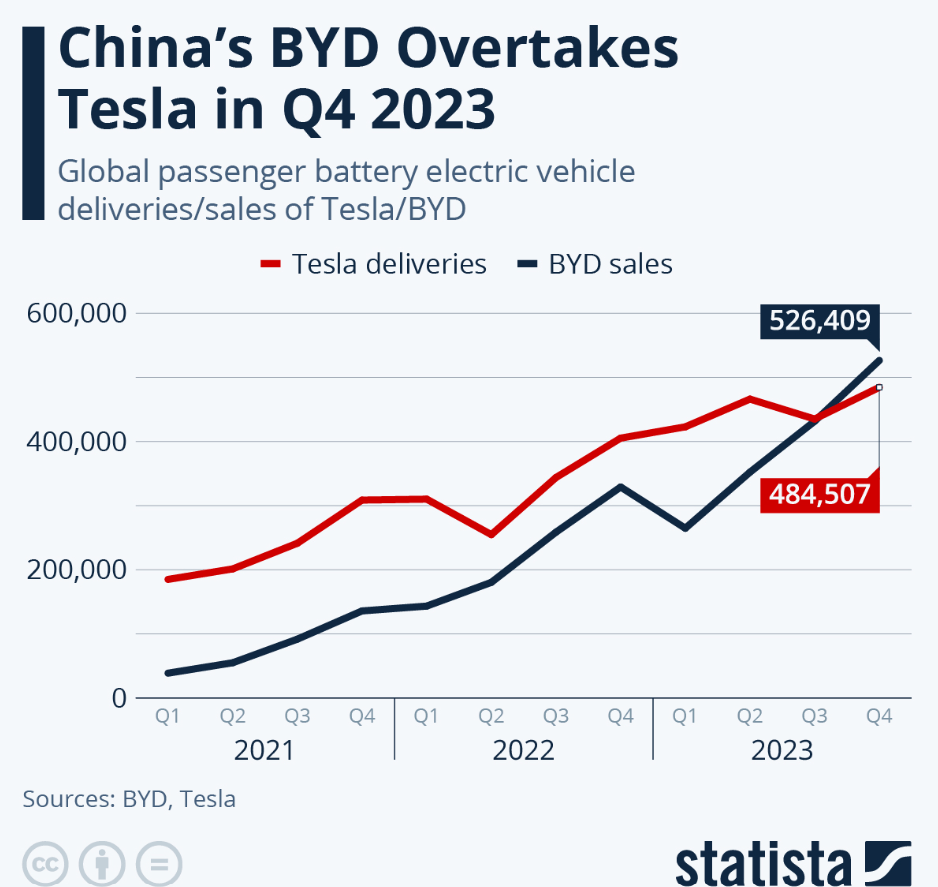
Tesla delivered 495,570 EVs in Q4, up from 462,890 in Q3 and besting its prior record of 484,507 in Q4 2023.
That was below estimates for about 506,000 and implied company guidance of 515,000 or more, despite a slew of discounts and incentives late in the year.
Tesla relied even more in Q4 on China sales, which tend to be lower margin.
Cybertruck deliveries appeared to slow in Q4, even with the shift to the non-Foundation series that cut the starting price to $79,990. On Jan. 1, the dual-motor Cybertruck became eligible for the $7,500 tax credit. That could boost demand, at least in the short run. But Tesla is likely losing money on the new EV at the lower price.
For the full year, Tesla delivered 1,789,226 EVs, down 1% from 2023’s 1,808,591. The EV giant, on the Q3 earnings call, had predicted slight delivery growth for the full year.
Tesla also deployed 11 gigawatt-hours of energy storage products in Q4, a new record. It deployed 31.4 GWh for the full year.
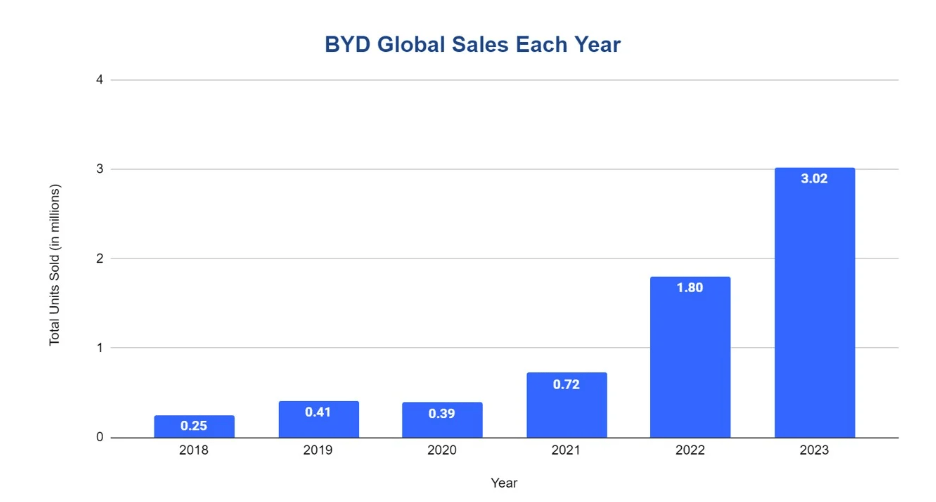
Meanwhile, BYD sold a record 1,524,270 vehicles in Q4, up 61% vs. a year earlier and more than triple Tesla’s total. Full-year sales jumped 41% to 4,272,145.
Plug-in hybrids led the way in 2024, thanks to BYD’s new, longer-range hybrids. But passenger BEV sales ran to 595,413 in Q4, roughly 100,000 more than Tesla. For the year, BYD came in with 1,764,992 BEVs, just shy of Tesla’s total.
In January, BYD sold 300,358 EVs in January, up 49% vs. a year earlier but down 42% vs. December’s record. February sales of 322,846 swelled nearly 164% vs. a year earlier and 7.4% above January’s pace. China auto sales are sluggish to start the year, due to Lunar New Year holidays, but pick up again in the spring.
It’s possible Tesla will regain the BEV title in Q1. However, Tesla has started 2025 with weak sales.
New Tesla Model Y Deliveries Begin
Tesla began deliveries of the new Model Y in China on Feb. 26. U.S. and European deliveries began in early March.
The new MY has has a clearly different front and back, with a light bar similar to that of the Cybertruck, as well as many other EVs.
A Model 3 revamp in late 2023, like the Model S and Model Y updates, didn’t provide much of a sales boost. Those refreshes had some real internal improvements but barely perceptible exterior changes.
The “Juniper” Model Y has a slightly higher price in China. In the U.S. and Europe, a special-edition Model Y Launch series carries a big premium, especially in the U.S. where FSD will be included. Meanwhile, Tesla is offering hefty inventory discounts on the original Model Y.
But wait times for the new Model Y are low in the U.S. and China.
Tesla’s ‘Affordable’ EV
The EV giant in 2024 ditched long-touted plans for a “next-generation” EV and “revolutionary” manufacturing. Tesla now plans “affordable vehicles,” using existing production lines.
In the Q4 earnings report, Tesla said it still sees output of the “affordable” vehicle starting in the first half of 2025. That would suggest mass production and a delivery start date in late 2025 or beyond.
Musk, on the Q3 call, said the new EV should be sub-$30,000 after incentives. If that means the $7,500 IRA tax credit, the list price would be below $37,500, but perhaps not by much.
Tesla still hasn’t even shown images for the upcoming “affordable” vehicle.
The speculation is that Tesla will produce a lower-cost variant of the Model 3 or Model Y, perhaps a hatchback. It’s unclear how a low-end EV might fare outside the U.S., without IRA credits. There are many small EVs in Europe and especially China, where a quality ride can go for well under $25,000 or even $15,000. The BYD-led push to make driver-assist features standard on cheap EVs is another issue for an “affordable” Tesla EV.
As for the Tesla Semi, the EV giant has delivered a few dozen to PepsiCo (PEP). A few more customers, including Walmart (WMT), had taken possession of at least one Tesla Semi. But it’s still unclear what the specs and price for the EV big rig are. Tesla recently said it expected mass production in 2026, but Semi timelines have often slipped by years.
BYD Expansion
‘BYD sells BEVs and PHEVs from around $10,000 to $150,000, including its premium Denza, FangChengBao and Yangwang brands.
Its latest hybrid system offers touted 2,100 kilometers (1,305 miles) in combined battery-and-gas range.
Improved driver-assist systems and faster charging also are expanding to more of BYD’s lineup.
Overseas sales are surging in the past few months.
Export logistics have improved, in terms of ships and rail, with several more ro-ro ships coming into service this year.
BYD’s Thailand plant, its first full-assembly plant outside of China, is still ramping up. There’s also a knockdown plant in Uzbekistan, which puts together partially assembled vehicles.
A Brazil factory is due to open in early 2025. The EV giant will have a Hungary plant up and running by early 2026. BYD also is building or plans to build factories in Hungary, Indonesia, Turkey, Cambodia and Pakistan.
Turkey has a customs union with the EU. That, along with the Hungary plant, will be two factories for Europe. The Cambodia and Pakistan plants will likely be knockdown plants.
The EV giant has held off on a choosing a Mexico site. BYD may be waiting on Trump developments.
BYD makes EV buses in California but says it has no plans to enter the U.S. passenger EV market, amid import tariffs and political opposition. However, Trump has said he wants Chinese EV makers to build cars in the U.S.
Tesla Vs. BYD Batteries
Tesla traditionally has not mass-produced its own batteries. For lithium-ion batteries, its joint venture partner Panasonic makes the cells and Tesla packages them. It also buys lithium-ion batteries from South Korea’s LG. Tesla also buys a lot of lithium iron phosphate (LFP) batteries from China’s CATL as well as some LFP batteries from BYD.
Tesla is working on 4680 batteries, first touted at the 2020 Battery Day. The 4680 batteries are standard lithium-ion chemistry, but the EV giant claimed the larger form factor offers the potential for various benefits and cost savings. Tesla’s 4680 production has picked up.
Tesla has hinted at progress on the “dry cathode” problem, but reportedly mass-production issues remain. It appears that the 4680 battery density is only now reaching that of traditional 2170 cells. Tesla does get some IRA tax credits from making its own batteries.
Tesla is a major battery storage provider, though it gets its batteries from CATL and soon BYD.
BYD’s New Blade Battery
BYD, meanwhile, is one of the world’s largest EV battery makers. Its Blade batteries are a specialized form of lithium ferrous phosphate (LFP) or lithium iron phosphate batteries. BYD supplies third-party EV makers, including Xiaomi, XPeng’s Mona subbrand, Nio’s Orvo brand and Toyota. BYD supplies some EV batteries to Tesla.
BYD reportedly will unveil a next-generation Blade battery in 2025, with longer range and faster charging. That, along with various other models, could help rev up BEV sales growth.
BYD expects at least “demonstration use” of solid-state batteries (SSB) for high-end models by 2027, but not fully reaching lower-end models until 2030-32. SSBs are expected to allow for much-higher battery density and charging.
BYD is a major battery storage provider. It reportedly is a supplier to Tesla’s new Shanghai Megapack factory.
Tesla Full Self-Driving
Around Thanksgiving, Tesla began rolling out FSD v13, which is only available to vehicles with Hardware 4.0.
FSD v13 does appear to show a modest boost increase in miles per critical disengagement. But the unofficial FSD Community Tracker, endorsed by Elon Musk several times, signal it’s a long way from even approaching robotaxi status.
Musk said on the Q4 earnings call that Tesla will begin paid robotaxi rides in Austin this June. But he’s said for years that Tesla would achieve self-driving “this year” or “next year.”
At the Tesla robotaxi event, Elon Musk showed off the two-seat Cybercab, with no steering wheel. Musk expects the Cybercab price tag will be below $30,000, with production starting “before 2027.”
Tesla in late February rolled out some more driver-assist features in China. But the new offerings don’t match U.S.-based FSD. It appears that Tesla still needs to get a license to introduce FSD.
Tesla has hoped for a burst of FSD subscriptions and EV sales from a China launch. But BYD and other China EV makers making Level 2 ADAS standard will limit how much the U.S. giant can charge for FSD in China, if anything.
The Tesla FSD price is $8,000 in the U.S., down from a peak of $15,000. The FSD subscription price is $99 a month.
On the Q4 earnings call, Tesla conceded EVs running Hardware 3.0 won’t achieve FSD, despite Musk’s past pledges that they were “hardware ready.” Tesla had previously promised that it would upgrade HW3.0 vehicles if they couldn’t achieve self-driving.
Tesla could introduce Hardware 5.0 later this year.
BYD Self-Driving
BYD has been spending massively on driver-assist and smart car software, racing to catch up to industry-leading peers and to lower the costs.
On Feb. 10, BYD held a smart car event, announcing it’s rolling out Level 2 driver-assistance systems to more affordable vehicles.
All models above 100,000 RMB ($13,688) will come standard with L2+ ADAS, even the Seagull, which starts below $10,000.
More-expensive BYD EVs will get more advanced ADAS, with some featuring lidar.
The smart-car push could be a big selling point and enhance the brand significantly. It’s generally assumed that BYD’s system will have relatively low ADAS component costs, making it hard for rivals to keep pace.
Tesla’s Other Businesses
Tesla has its own Supercharger network in its markets. That’s key in the U.S., where charging facilities are limited.
Tesla has deals with most automakers for access to Superchargers in the U.S. They are adopting the charger standard that Tesla uses. Those deals, and some related charging subsidies, will boost revenue.
But they reduce Tesla’s charging moat in the U.S., which encouraged people to buy its EVs. U.S. EV and hybrid sales rose sharply in Q4 for automakers other than Tesla.
Tesla also has a solar installation business, but it’s been struggling for years.
Tesla also is pursuing a humanoid robot, Optimus, with Musk saying he expects it to be a multitrillion-dollar business, with sales beginning in the first half of 2026.
“We should be thought of as an AI or robotics company,” Musk has told investors. “If somebody doesn’t believe Tesla is going to solve autonomy, I think they should not be an investor.”
BYD’s Other Businesses
BYD, notably, makes its own chips. That, along with in-house batteries and other vertical integrations, helps make BYD a low-cost EV maker.
The EV and battery giant also has solar operations.
BYD Co. is largely known for its BYD Auto operations. BYD Electronics, which accounts for an increasingly smaller share of overall revenue, is involved in mostly low-margin businesses such as smartphone components and assembly, including for the Apple iPhone. But margins are improving there as well.
EU Hikes Tariffs On Chinese EVs
The European Union now imposes additional tariffs of up to 35.3% on Chinese BEVs. That’s on top of prior 10% duties.
Specifically, the EU will impose an extra 17% tariff on BYD’s BEVs. But the new duties don’t apply to PHEVs, a big plus for BYD. The upcoming Hungary and Turkey plants will let the BYD sidestep EU tariffs altogether in the future.
The EU only imposes a 7.8% extra tariff on Tesla’s China made-vehicles. Tesla Shanghai exports the Model 3 to the EU.
Tesla Earnings
In the fourth quarter, Tesla earnings rose 3% vs. a year earlier while revenue edged up 2% to $25.7 billion, the second straight quarter of year-over-year gains. But those missed views. Also, earnings would have fallen significantly without the inclusion of a unrealized gain from Tesla’s bitcoin holdings.
After a surprise jump in Q3, gross margins sank to 16.3%. Auto gross margins excluding regulatory tax credits tumbled to a multiyear low of 13.6%, well below views. Tesla Energy margins will still high, but came down significantly.
On the Q4 call, Musk did not repeat his forecast for 20%-30% delivery growth in 2025 and generally signaled that the EV business would be lackluster yet again this year. There was still nothing concrete about “affordable” vehicles.
Instead, the focus was almost entirely on optimism about self-driving and the Optimus robot.
In the wake of Tesla’s poor-quality Q4 earnings, minimal guidance and signs of weak sales to start the year, analysts have slashed 2025 EPS targets. If the past two years are any guide, they’ll come down a lot more
BYD Earnings
BYD’s Q3 earnings rose 16%, slightly above views. Sales jumped 29% to $28.7 billion, with growth accelerating for a second straight quarter but just missing views. However, BYD revenue topped Tesla’s for the first time.
BYD’s gross margin was 21.89% vs. 18.96% a year earlier. BYD Auto margins popped to 23.51% vs. 22.51% in Q3 2023.
R&D and capital spending costs continue to climb rapidly.
BYD will finally report Q4 and full-year results in late March. Analysts expect Q4 EPS surged 69% with revenue up 50%.

Tesla Vs. BYD Market Cap
Tesla stock has a market cap of $741.7 billion as of March 11. That’s still far above BYD’s $122.8 billion.
Tesla Stock Technicals
Tesla stock is down 42.9% so far in 2025 as of March 11.
From an April 2024 low of 138.80, Tesla stock skyrocketed to 488.54 on Dec. 18. Most of that came after Q3 earnings — with Musk making bullish forecasts about Q4 sales, 2025 growth and robotaxis — but especially after Trump’s election.
But Tesla stock has tumbled since then, losing more than half its value from all-time highs.
Shares tried to clear a trendline entry on Jan. 31, soon after earnings, but since then has dived. TSLA stock has fallen below its 200-day line and round-tripped its post-election gains, hitting its lowest level since Q3 earnings on Oct. 23.
Concerns about Tesla’s growth and robotaxis as well as and fears about Musk’s focus and impact on Tesla’s brand image are taking a toll on TSLA stock.
BYD Stock Technicals
BYD stock is up 32.35% in 2025 as of March 11, pulling back after hitting a record 52 on Feb. 26. Shares skyrocketed in February on self-driving moves. Analysts are raising price targets, in part on expectations for surging EV sales through 2026 and beyond.
BYD is technically back in range from a base with a 42 buy point and has cleared the old record high from back in June 2022.
BYD, listed in Hong Kong and Shenzhen, trades over the counter in the U.S. Its U.S. shares often have mini-gaps as well as opening trade mini-spikes or tumbles before settling down.
Trump Election Impact
Elon Musk was a huge supporter of Trump’s election bid, contributing hundreds of millions of dollars and actively campaigning with him. There was widespread hope that the Trump administration will help Tesla, though exactly how is unclear. Getting rid of the $7,500 tax credit on EVs would be a negative for Tesla in the short run. Rolling back fuel-economy standards would have a mixed impact on Tesla. Trump’s team reportedly wants a federal framework for self-driving vehicles, something Musk has argued for. But regulation isn’t the main hurdle for Tesla robotaxis, which face no restrictions in states such as Texas and Florida.
Meanwhile, Musk’s high-profile role in the Trump administration, along with his political comments regarding the U.S., U.K., Germany and Ukraine appear to be further eroding Tesla’s brand in the U.S. and Europe, especially with groups most likely to buy an EV.
On March 11, Trump announced he was buying a Tesla to support Elon Musk.
Trump tariff hikes on China won’t have much impact on BYD directly, but could hit China’s economy. Tesla China sales also could be hurt. And there’s always the potential for patriotic boycotts or various government action against the EV maker.
There is one potential massive wild card. Trump has voiced his support for Chinese EV makers setting up plants in the U.S. If he did so, BYD would likely rush to take advantage.